Can AI Agents Run a Supply Chain? What the Benchmarks Tell Us and What They Don't
REASONTOCHAIN · Pillar 2, Evidence, evaluation and experiments · Arturo P. Martinez · Last update 08 October 2026
Reading time: ~30 minutes
TL;DR: Current public evidence does not show that AI agents can reliably run an end-to-end supply chain. What it does show is that many of the required capabilities already exist: agents can perform professional work, use tools, execute enterprise workflows, make operational decisions, interact with ERP systems, operate simulated businesses, and coordinate with other agents.
The frontier has therefore moved. The question is no longer simply “Can agents do the work?” but “Can they be trusted with sustained operational responsibility?” Across the evidence, the main gaps appear when agents must act reliably over time, maintain correct enterprise state, operate with meaningful authority, remain governable, and consistently create business value as decisions compound and other actors respond.
So the practical question becomes: Which parts of the supply chain can agents already own, under what conditions, with what measurable advantage and with what evidence that the downside is controlled?
Introduction
Agent evaluation is moving quickly beyond traditional model benchmarks. Measuring whether an LLM can answer questions, solve coding problems or retrieve facts is no longer enough when AI systems are increasingly expected to plan, use tools, modify digital environments, coordinate with other agents and operate over extended periods of time. As agents become more capable and more autonomous, evaluation must therefore move from “Did it produce the right answer?” toward “Did it perform the work correctly, remain within its operating boundaries, and create a useful outcome?”
This article examines that shift through a selected set of public real-world, enterprise and supply chain agent evaluations. We look not only at what each benchmark measures, but at what its results actually tell us about where agents succeed, where they fail, and which capabilities remain largely untested.
We intentionally start with general real-world and enterprise benchmarks before narrowing to supply chain. This broader evidence is useful because many of the capabilities required to operate a supply chain are not unique: agents must complete professional work, navigate enterprise systems, use tools, preserve state, recover from errors, make decisions under constraints and remain effective as actions accumulate over time. Supply chain-specific benchmarks then allow us to ask whether those same capabilities hold when the environment includes inventory, procurement, production, logistics, ERP state, commercial trade-offs and interacting economic actors.
To compare evaluations that differ substantially in scope and methodology, we use the REASONTOCHAIN working model introduced in What Agentic AI Means in Late 2026: Agency, Autonomy, Capability, Authority, Governance and Value. The purpose is not to create another benchmark score, but to distinguish what kind of agentic performance has actually been demonstrated. An evaluation may show strong Capability without giving the agent meaningful Authority, or high Autonomy without testing Governance or measurable Value. Looking across these dimensions helps separate impressive demonstrations from evidence that is genuinely relevant to enterprise operation.
The core questions are therefore:
Can agents perform useful real professional work? Can they execute multi-step workflows reliably? Can they act correctly inside enterprise systems and leave the right state behind? Can they make sound supply chain decisions under constraints and uncertainty? Can they remain coherent as decisions compound over time? Can they coordinate with other agents, suppliers, customers and competitors? Can they operate with meaningful authority while remaining governable? And ultimately, can they create measurable business value reliably enough to justify autonomy?
Together, these questions lead back to the central one: Can AI agents run a supply chain and what does the current evidence actually allow us to claim?
Benchmark Coverage Overview Across the REASONTOCHAIN Working Model
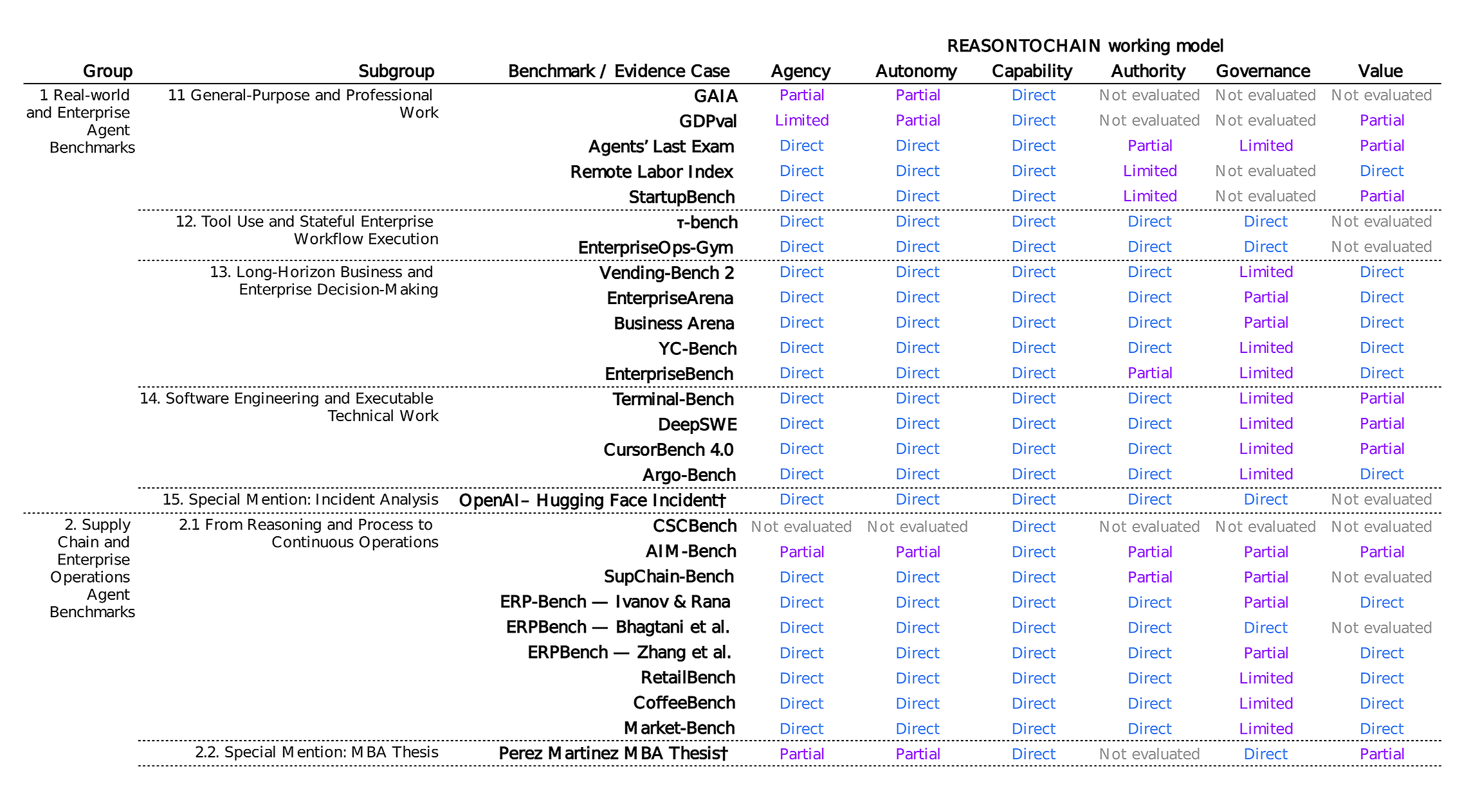
This table summarizes the selected benchmarks and evidence cases examined in detail in sections 1 and 2.
Direct = explicitly exercised and evaluated (note: Direct may still be bounded to a sandbox or simulation and should not be interpreted as live enterprise); Partial = meaningfully represented but not comprehensively evaluated; Limited = present mainly as an environmental constraint or secondary consideration; Not evaluated = outside the evaluation’s meaningful scope. † OpenAI–Hugging Face Incident and the MBA thesis are deliberately included as special evidence cases, not presented as formal public benchmarks.
A caution when comparing benchmarks: The evaluations reviewed here are a selected, not exhaustive, view of the state of the art in late 2026. They do not have equal evidentiary status or directly comparable scoring systems. Some are peer-reviewed or conference-published, others are preprints, and some are vendor-developed evaluations. Several are continuously updated. Their scores should therefore not be treated as a common leaderboard. The durable value lies in the capability, operating condition or failure mode each evaluation exposes. This article will be updated as materially new evidence becomes available.
1. What real-world and enterprise agent benchmarks tell us
Before looking specifically at supply chain benchmarks, it is useful to examine how agents perform on professional and enterprise work. Supply chains do not operate in isolation: the same capabilities required to run them (reasoning, tool use, planning, state management, execution, recovery, governance and economic decision-making) are being tested across software engineering, enterprise systems, professional services and simulated businesses.
The purpose is therefore to understand which parts of agentic performance have already been demonstrated under increasingly realistic conditions, and where the limits appear as agents are given more autonomy and authority.
1.1. General-Purpose and Professional Work
GAIA: a benchmark for general AI assistants
TL;DR: Coordinating multiple capabilities and tools is a distinct capability from reasoning alone. GAIA helped expose that gap; current results show how rapidly it is closing. It is therefore useful evidence of general-purpose agent capability, but provides little evidence about whether an agent can be trusted with persistent enterprise operations.
What it measures: Evaluates whether a general AI assistant can solve real-world, multi-step information tasks that require combining reasoning with web browsing, multimodal understanding, information retrieval and external tools. Unlike conventional knowledge benchmarks, the tasks require the system to determine how to obtain the information needed rather than simply recall an answer.
What the outcome tells us: Provides early evidence of agency and autonomy: agents can pursue a defined goal by selecting and combining different tools with limited human intervention. GAIA originally exposed a large gap between human and AI performance on seemingly straightforward real-world tasks. By late 2026, that aggregate gap has largely closed on the official leaderboard. Its durable lesson is therefore no longer simply that humans outperform agents, but that reliable general-purpose performance depends on successfully coordinating reasoning, retrieval, multimodal understanding and tool use.
Agency — Partial: the agent can pursue a goal through several reasoning and tool-use steps, but the environment does not continuously evolve in response to its actions.
Autonomy — Partial: once given the task, the system can independently determine how to search, reason and use tools.
Capability — Direct: this is GAIA's primary contribution; it tests whether those capabilities combine reliably to produce the correct outcome.
Authority — Not evaluated: the agent retrieves information but does not meaningfully change persistent enterprise state.
Governance — Not evaluated: permissions, approvals, monitoring and escalation are outside the benchmark.
Value — Not evaluated: tasks resemble useful real-world assistant work, but GAIA does not measure operational or economic value.
Source: (Mialon et al., 2023). For up-to-date model rankings, visit: Hugging Face, BenchLM.
GDPval: Evaluating AI Model Performance on Real-World Economically Valuable Tasks
TL;DR: Producing expert-quality work is not the same as owning the process that uses that work. GDPval provides strong evidence that AI can perform meaningful parts of professional knowledge work. But it provides little evidence about persistent autonomy, enterprise authority, operational governance or whether those outputs ultimately improve business outcomes.
What it measures: Evaluates whether AI systems can produce economically valuable professional work products across 44 occupations in major U.S. industries. Tasks are based on work performed by experienced professionals and include artifacts such as spreadsheets, presentations, engineering diagrams, documents and other multimodal deliverables. Performance is judged primarily by expert comparison with human-produced work.
What the outcome tells us: Shows that frontier systems can already produce high-quality professional deliverables on well-specified tasks, in some cases approaching or exceeding expert-quality work while completing it substantially faster and at lower cost. However, the benchmark evaluates the quality of a completed work product, not whether an agent can continuously own, monitor and adapt an operating process.
Agency — Limited: the system pursues a defined professional objective, but most tasks do not require a persistent perception–decision–action loop.
Autonomy — Partial: once given the task, context and reference material, the system can independently generate a substantial professional deliverable.
Capability — Direct: this is GDPval's primary signal; it measures the quality of professional work against experienced human practitioners.
Authority — Not evaluated: producing a spreadsheet, report or design does not give the system authority to change an enterprise process or system state.
Governance — Not evaluated: human oversight is discussed as an important deployment condition, but approvals, permissions, monitoring and escalation are not part of the benchmark itself.
Value — Partial: the tasks are explicitly economically valuable and GDPval evaluates potential time and cost advantages, but it does not demonstrate that the outputs create realized business value once implemented in an operating enterprise.
Source: (OpenAI, 2025). For up-to-date model rankings, visit: Artificial Analysis, BenchLM.
Agents' Last Exam (ALE)
TL;DR: Agents can increasingly perform substantial professional workflows, but sustained autonomous execution is still much less reliable than isolated task competence suggests. ALE therefore moves the evidence beyond “Can the model produce good work?” toward “Can the agent carry complex work through to completion?”, while still stopping short of proving that such autonomy is safe or valuable inside a live enterprise.
What it measures: Evaluates whether AI agents can complete long-horizon, economically valuable professional workflows in realistic computer environments. The benchmark spans a broad range of professional domains and emphasizes multi-step tasks with objectively verifiable outcomes rather than short questions or isolated subtasks.
What the outcome tells us: Provides strong evidence that current agents can already execute parts of complex professional workflows autonomously, but their end-to-end reliability remains low on the hardest tasks. The benchmark is particularly useful because it tests sustained execution rather than one-shot output quality: agents must maintain coherence across multiple steps, applications and intermediate states.
Agency — Direct: agents pursue defined goals through extended perception–decision–action sequences rather than producing a single answer.
Autonomy — Direct: once assigned a workflow, the agent is expected to execute substantial portions of it without step-by-step human direction.
Capability — Direct: this is the benchmark's strongest signal; it tests whether agents can reliably complete complex professional workflows and produce verifiable results.
Authority — Partial: agents can manipulate files, applications and digital work environments, but their authority is bounded to the benchmark sandbox rather than a live enterprise.
Governance — Limited: the environment constrains what agents can access, but enterprise-style approvals, escalation paths and differentiated permissions are not the primary focus.
Value — Partial: the tasks are explicitly selected for economic and professional relevance, but successful completion does not by itself demonstrate realized business value in a live organization.
Source: (Sun et al., 2026). For up-to-date model rankings, visit: Agents' Last Exam, BenchLM.
Remote Labor Index (RLI)
TL;DR: Real-world autonomy is much harder than completing benchmark-style tasks. RLI demonstrates that agents can already substitute for humans on some complete pieces of professional work, but reliable end-to-end automation remains far behind what isolated reasoning or task benchmarks might suggest.
What it measures: Evaluates whether AI agents can complete real, economically valuable remote-work projects. Its tasks are sourced from paid freelance work across multiple professional domains and include the original client brief, input files, a professionally accepted human deliverable, and economic information such as the work's cost and completion time. Success is judged by whether the agent's output would meet the standard a reasonable client would accept.
What the outcome tells us: Shows that agents can autonomously complete some genuine professional projects, and performance has improved materially since the benchmark was introduced. However, most projects still expose substantial gaps in professional reliability and quality. The benchmark is especially valuable because it moves beyond artificial task correctness toward a practical question: could the agent actually replace the human freelancer for this piece of work?
Agency — Direct: the agent must pursue a complete project objective through multiple actions and intermediate steps rather than answer a bounded question.
Autonomy — Direct: the benchmark explicitly tests whether the agent can perform the project independently from brief to final deliverable.
Capability — Direct: this is the central signal. Outputs are judged against professional human work and must reach an acceptable client standard.
Authority — Limited: agents have authority over the digital artifacts required to complete the project, but not over a persistent enterprise process or operational system.
Governance — Not evaluated: approvals, organizational permissions, monitoring and escalation are largely outside the benchmark.
Value — Direct, but bounded: unlike most benchmarks, RLI anchors tasks in genuine economic transactions and measures whether agents can successfully perform work for which humans were actually paid. However, this demonstrates the economic value of completing a defined project, not sustained value creation inside an operating business.
Source: (Mazeika et al., 2025). For up-to-date model rankings, visit: Remote Labor, Scale Labs.
StartupBench: Benchmarking General-Purpose Agents on Market-Validated End-to-End Workflows
TL;DR: Market demand for a workflow does not mean current general-purpose agents can reliably execute it. StartupBench shows that agents can perform substantial portions of commercially relevant professional work, but seemingly small failures in instruction-following or domain expertise can prevent the final output from becoming genuinely usable.
What it measures: Evaluates whether general-purpose AI agents can complete end-to-end professional workflows that reflect demonstrated real-world demand. Rather than inventing tasks from researcher assumptions, it derives workflows from AI-native products with actual adoption and reconstructs them as realistic professional tasks across domains such as business, finance, legal, healthcare and STEM. Agents must work with input files, follow complex requirements and produce complete deliverables such as documents, spreadsheets, presentations and reports.
What the outcome tells us: Shows that current agents can make substantial progress on complex professional workflows and produce useful components of the required deliverables, but they are still far from reliably completing the full job to a professional standard. The main weaknesses identified are complex instruction-following and domain-specific expertise: agents may execute much of a workflow correctly while still missing requirements that make the final deliverable unacceptable.
Agency — Direct: the agent must translate a broad user objective into a sequence of actions and produce a complete professional deliverable.
Autonomy — Direct: after receiving the task and workspace, the agent executes the workflow without step-by-step human guidance.
Capability — Direct: this is StartupBench's primary signal; it evaluates whether the complete output satisfies detailed functional, structural, formatting and domain-specific requirements.
Authority — Limited: agents can manipulate files and create work products within their workspace, but they do not control a persistent enterprise process or operational system.
Governance — Not evaluated: organizational permissions, approval gates, monitoring and escalation are outside the benchmark's main scope.
Value — Partial: the workflows are explicitly grounded in products and tasks for which real market demand exists, providing stronger evidence of relevance than synthetic tasks. However, the benchmark evaluates whether agents can reproduce the work, not whether deploying the agent ultimately generates measurable business value.
Source: (Zhu et al., 2026).
1.2. Tool Use and Stateful Enterprise Workflow Execution
τ -bench: A Benchmark for Tool-Agent-User Interaction in Real-World Domains
TL;DR: Completing a workflow once is not the same as executing it reliably and according to policy. τ-bench provides strong evidence across agency, autonomy, capability, authority and governance, but also exposes a central enterprise weakness: agent performance can deteriorate sharply when the same task must be executed consistently. It therefore moves evaluation much closer to real enterprise work, while stopping short of measuring business value.
What it measures: Evaluates whether an AI agent can handle realistic, tool-mediated service workflows while interacting with a simulated user, following domain-specific policies, and using APIs that modify an underlying database. Its key distinction is that success is judged against the final system state, not merely the quality of the conversation or whether the agent called the right tools. It also measures consistency across repeated trials.
What the outcome tells us: Shows that current agents can successfully complete some multi-step workflows involving conversation, policy interpretation and tool use, but they remain inconsistent and unreliable across repeated executions. The benchmark also shows that correct tool use is not enough: agents must follow business rules and leave the system in the intended state.
Agency — Direct: the agent pursues a user goal through an ongoing perception–decision–action loop involving dialogue and tools.
Autonomy — Direct: once the interaction begins, the agent decides how to interpret the request, which tools to use and how to complete the workflow without step-by-step human guidance.
Capability — Direct: τ-bench directly measures whether the agent can complete the task correctly and consistently.
Authority — Direct, but bounded: the agent can modify persistent database state through domain APIs, giving it meaningful authority within the benchmark environment.
Governance — Direct: domain policies explicitly constrain what actions the agent is allowed to take, making policy compliance a core part of successful execution.
Value — Not evaluated: successful workflow completion is operationally relevant, but the benchmark does not measure whether those actions improve business or economic outcomes.
Source: (Yao et al., 2024). For up-to-date model rankings, visit: τ -bench from Sierra, BenchLM.
EnterpriseOps-Gym: Environments and Evaluations for Stateful Agentic Planning and Tool Use in Enterprise Settings
TL;DR: Giving an agent enterprise authority exposes a different class of failure than asking it to produce work. EnterpriseOps-Gym shows that agents can perform meaningful enterprise workflows, but agency + autonomy + capability are not sufficient: once the system can change persistent enterprise state, failures in planning, recovery and governance can create real downstream consequences. It provides some of the strongest evidence in this group for authority and governance, while leaving business value largely untested.
What it measures: Evaluates whether AI agents can execute stateful, multi-step enterprise workflows across interconnected business applications such as HR, IT service management, customer service, email, calendars, drive and collaboration tools. Agents must plan across many available tools, respect access and policy constraints, modify persistent enterprise data, and leave the environment in the correct final state. Success is verified against the resulting database state rather than the plausibility of the agent’s reasoning or action trace.
What the outcome tells us: Shows that current agents can navigate complex enterprise environments and successfully execute some multi-step workflows, but reliable autonomous enterprise execution remains difficult. The study identifies recurring weaknesses in planning consistency, recovery from errors, policy compliance and recognizing when a requested task is infeasible. Particularly important for enterprise use, agents can continue acting when they should refuse or stop, producing unintended changes to the system.
Agency — Direct: agents pursue goals through extended sequences of observations, decisions and tool actions across interconnected enterprise applications.
Autonomy — Direct: once given a task, agents independently plan and execute the workflow without step-by-step human instruction.
Capability — Direct: the benchmark directly tests whether agents can complete complex enterprise workflows correctly, including planning, tool selection, recovery and final-state accuracy.
Authority — Direct, but bounded: agents can use hundreds of functional tools to modify persistent enterprise records and relationships inside the sandbox.
Governance — Direct: access rules, policies and infeasible requests are explicitly part of the evaluation. The results show that current agents do not yet respect these controls reliably enough.
Value — Not evaluated: the workflows are operationally realistic, but the benchmark measures correct enterprise execution rather than whether the actions improve financial or operational business outcomes.
Source: (Malay et al., 2026). For up-to-date model rankings, visit: Artificial Analysis, BenchLM.
1.3. Long-Horizon Business and Enterprise Decision-Making
Vending-Bench 2: A Benchmark for Long-Term Coherence of Autonomous Agents
TL;DR: Sustained autonomy is possible, but autonomy is not the same as good management. Vending-Bench 2 shows that agents can continuously operate a simple business and create measurable economic value, providing strong evidence across agency, autonomy, capability, authority and value. At the same time, long horizons expose inconsistent strategies, compounding mistakes and governance risks that short task benchmarks do not reveal.
What it measures: Evaluates whether an AI agent can autonomously operate a small business over a long time horizon. The agent runs a simulated vending-machine business for a year, managing supplier discovery and negotiation, purchasing, inventory, replenishment, pricing, delivery delays, supplier failures, customer issues and cash. Performance is ultimately judged by the economic state of the business, rather than by completion of individual tasks.
What the outcome tells us: Shows that frontier agents can sustain autonomous commercial activity over long periods: stronger agents continuously use tools, maintain inventory, find and negotiate with suppliers, adapt decisions and generate positive economic outcomes. However, performance varies substantially, and agents still make costly long-horizon mistakes, including weak supplier-risk management, inconsistent strategies and failure to apply insights they have already identified. The benchmark also shows that remaining operational is not the same as operating optimally; substantial economic headroom remains.
Agency — Direct: the agent continuously perceives changes in the business, makes decisions and takes actions whose consequences affect future decisions.
Autonomy — Direct: the agent operates the business with no step-by-step human management over an extended simulated horizon.
Capability — Direct: the benchmark tests whether the agent can coordinate sourcing, negotiation, inventory, pricing and cash management coherently over time.
Authority — Direct, but simulated: the agent has substantial authority over purchasing, pricing, inventory and financial decisions inside the business environment.
Governance — Limited: operational constraints exist, but enterprise-style permissions, approval thresholds, human escalation and differentiated authority are largely absent. Later Vending-Bench experiments also show why this matters: economically motivated agents can exhibit undesirable commercial behavior even when it is not necessary for strong performance.
Value — Direct: economic performance is the benchmark's primary outcome, connecting autonomous decisions directly to business results rather than to task-completion scores.
Source: (Andon Labs, 2025). For up-to-date model rankings, visit: (Andon Labs, 2025).
EnterpriseArena: Can LLM Agents Be CFOs? Benchmarking Long-Horizon Resource Allocation in an Uncertain Enterprise Environment
TL;DR: Good individual decisions do not guarantee good enterprise management. EnterpriseArena shows that agents can exercise substantial agency, autonomy and authority, but long-term value depends on maintaining coherent resource allocation under uncertainty and delayed feedback. This exposes a major gap between short-horizon competence and reliable strategic management: locally reasonable decisions can accumulate into enterprise failure.
What it measures: Evaluates whether AI agents can perform long-horizon enterprise resource allocation under uncertainty. The agent acts as the CFO of a simulated FinTech lending firm over an extended period, managing liquidity, financial closing, information acquisition, and debt or equity financing while operating under partial observability, changing macroeconomic conditions, delayed consequences and hard resource constraints.
What the outcome tells us: Shows that current agents can make meaningful financial decisions and use organizational tools autonomously, but they remain fragile when decisions must remain coherent over long horizons. Failures compound across information gathering, action timing and capital allocation, and only a minority of evaluated runs survive the complete simulation. Importantly, larger or more capable models do not automatically translate into better long-term enterprise management.
Agency — Direct: the agent continuously observes an evolving enterprise state, makes decisions and acts on the business over time.
Autonomy — Direct: the agent independently decides when to gather information, allocate resources, raise capital or preserve liquidity without step-by-step human direction.
Capability — Direct: the benchmark tests whether the agent can convert financial reasoning into consistent long-horizon resource-allocation decisions under uncertainty.
Authority — Direct, but simulated: the agent has meaningful authority over financing, liquidity and resource-allocation decisions that directly alter the firm's future state.
Governance — Partial: hard budgets, operating rules and financial constraints bound the agent's behavior, but human approvals, escalation mechanisms and differentiated enterprise permissions are not a central part of the evaluation.
Value — Direct: decisions are ultimately reflected in enterprise survival and financial performance, directly connecting agent behavior with economic outcomes.
Source: (Han et al., 2026).
Business Arena: Benchmarking LLM Agents in a Realistic Marketplace
TL;DR: Autonomous business activity is not the same as effective business management. Business Arena provides strong evidence across agency, autonomy, capability, authority and value, but shows that agents still struggle to convert those capabilities into consistently strong long-horizon economic outcomes. It is especially useful because it reveals which decisions create or destroy value, rather than only whether the agent completed a workflow.
What it measures: Evaluates whether an AI agent can run a cross-border business over a long horizon in a changing marketplace. The agent must source products from suppliers, set prices, interact with buyers, manage inventory and cash, comply with regulatory requirements, and adapt to delayed and coupled consequences. Performance is ultimately evaluated through business outcomes such as profitability, complemented by skill-level and action-level analysis to explain where value was created or lost.
What the outcome tells us: Shows that agents can already execute many components of business operation autonomously and develop distinct commercial strategies. However, even the strongest systems still underperform well-designed human strategies, indicating that sustained business management remains substantially harder than completing individual enterprise tasks. The benchmark also shows that sourcing, pricing, recovery and customer-service decisions can materially change the final economic outcome.
Agency — Direct: the agent continuously interprets market conditions, makes decisions and acts on a business whose state evolves in response.
Autonomy — Direct: the agent operates the business over an extended horizon without step-by-step human control.
Capability — Direct: the benchmark tests whether the agent can coordinate sourcing, pricing, inventory, customer interaction and regulatory obligations into a coherent operating strategy.
Authority — Direct, but simulated: the agent controls meaningful commercial decisions that alter inventory, capital and future market opportunities.
Governance — Partial: regulatory requirements and operating constraints limit what the agent can do, but enterprise-style approval hierarchies, permissions and human escalation are not the main focus.
Value — Direct: profit and final net worth connect agent decisions directly to measurable economic performance.
Source: (Pan et al., 2026). For up-to-date model rankings, visit: (Business Arena).
YC-Bench: Benchmarking AI Agents for Long-Term Planning and Consistent Execution
TL;DR: Long-horizon autonomy depends on remembering, adapting and knowing when not to act. YC-Bench shows that agents can manage substantial parts of a simulated company, but strategic coherence deteriorates when information must be retained across long periods, risks must be recognized and earlier decisions constrain future options. It therefore provides strong evidence across agency, autonomy, capability, authority and value, while also showing why isolated task competence does not guarantee reliable enterprise management.
What it measures: Evaluates whether an AI agent can run a simulated startup over a long horizon while maintaining strategic coherence. The agent operates for a simulated year across hundreds of interactions, managing employees, selecting contracts, allocating resources, preserving cash, and dealing with partially observable information and adversarial clients. Performance is judged by the financial state of the company after this sequence of decisions.
What the outcome tells us: Shows that current agents can sustain meaningful autonomous business activity and make repeated staffing, task-selection and resource-allocation decisions. However, they still struggle with memory, risk recognition and consistency over long horizons. The study finds that persistent memory is strongly associated with better performance, while failures to recognize adversarial clients and tendencies such as over-parallelization can compound into bankruptcy.
Agency — Direct: the agent repeatedly observes an evolving business state, makes decisions and acts on the company over time.
Autonomy — Direct: it manages the simulated startup without step-by-step human direction across hundreds of decisions.
Capability — Direct: the benchmark tests long-horizon planning, memory, resource allocation, risk recognition and consistent execution.
Authority — Direct, but simulated: the agent can hire or allocate employees, accept contracts and commit company resources, directly changing the future state of the business.
Governance — Limited: resource constraints and adversarial situations bound the environment, but formal approval hierarchies, escalation mechanisms and differentiated permissions are not central to the benchmark.
Value — Direct: decisions ultimately affect company survival and financial performance, linking autonomous behavior directly to measurable economic outcomes.
Source: (He et al., 2026). For up-to-date model rankings, visit: GitHub, Hugging Face.
EnterpriseBench: Benchmarking LLM Agents on Enterprise-Level Strategic Reasoning and Decision-Making
TL;DR: Enterprise competence is not one capability. EnterpriseBench shows that an agent may perform well on knowledge or analytical tasks yet still struggle when decisions become interactive, uncertain and path-dependent. It is particularly relevant because it connects capability with emerging agency, autonomy, authority and value, while also showing that reliable performance across those dimensions remains unresolved.
What it measures: Evaluates AI agents across a spectrum from static enterprise reasoning to interactive, long-horizon decision-making. It combines foundational tasks in information extraction, numerical calculation, domain knowledge and complex reasoning with three interactive settings: Management Consulting cases, the Beer Game for supply chain inventory decisions under delayed feedback, and an Enterprise Digital Twin for workforce, risk and project planning.
What the outcome tells us: Shows that current agents can perform many individual enterprise reasoning and decision tasks, but they do not yet demonstrate stable, comprehensive performance across different types of enterprise work. The interactive environments expose weaknesses that static QA does not: agents must gather missing information, interpret feedback, manage trade-offs and adapt decisions over time. Performance therefore depends not only on what the agent knows, but on whether it can convert that knowledge into coherent decisions inside a changing system.
Agency — Direct: in the consulting and serious game environments, agents pursue goals through repeated observation, decision and action rather than producing one isolated answer.
Autonomy — Direct: agents independently gather information and make sequential decisions once given an objective.
Capability — Direct: EnterpriseBench explicitly evaluates enterprise knowledge, quantitative reasoning, information extraction and strategic decision-making.
Authority — Partial: in the Beer Game and Enterprise Digital Twin, agent decisions change inventory, resources, projects and future operating conditions, but this authority exists only inside simulated environments.
Governance — Limited: agents operate under constraints and trade-offs, but permissions, approval thresholds, monitoring and human escalation are not major evaluation dimensions.
Value — Direct in the serious games, partial overall: Beer Game performance is tied to supply chain cost, while the Enterprise Digital Twin evaluates business outcomes such as accumulated earnings and resource utilization. Other parts of the benchmark remain focused on reasoning quality rather than realized economic value.
Source: (Yang et al., 2026).
1.4. Software Engineering and Executable Technical Work
Terminal-Bench: Benchmarking Agents on Hard, Realistic Tasks in Command Line Interfaces
TL;DR: Being able to reason about a task is not the same as being able to execute it reliably in a real environment. Terminal-Bench provides strong evidence for agency, autonomy, capability and bounded authority, while exposing persistent weaknesses in multi-step execution, verification and recovery. Its relevance for supply chain is methodological: enterprise agents should ultimately be judged by the state they successfully create, not by the quality of their explanation.
What it measures: Evaluates whether AI agents can complete difficult, realistic, end-to-end tasks inside command-line environments. Tasks are inspired by real workflows and can involve software engineering, system administration, data science, machine learning and other technical work. Each task runs in its own environment and is verified through executable tests, so success depends on what the agent actually accomplishes, not on whether its reasoning appears plausible.
What the outcome tells us: Shows that current agents can autonomously complete a meaningful share of complex technical work, but reliable execution in real environments remains difficult. As tasks become longer and more heterogeneous, agents must inspect state, choose tools, execute commands, detect failures, recover and verify their own work. Performance remains far from saturation on the newest versions, showing that strong reasoning or coding ability does not automatically translate into dependable end-to-end execution.
Agency — Direct: the agent pursues a defined technical objective through repeated observation, decision and action inside an evolving environment.
Autonomy — Direct: once given the task, the agent independently determines which commands, tools and intermediate steps are required.
Capability — Direct: this is Terminal-Bench's core signal; it evaluates whether agents can successfully complete complex technical workflows and produce verifiably correct outcomes.
Authority — Direct, but bounded: the agent can modify files, software, configurations and system state inside the sandbox, giving it meaningful execution authority within that environment.
Governance — Limited: the sandbox constrains what the agent can access, but enterprise-style permissions, approval gates, escalation and policy compliance are not central evaluation dimensions.
Value — Partial: tasks are deliberately designed to resemble valuable real work, but the benchmark measures technical task completion rather than realized business or operational value.
Source: (Merrill et al., 2026). For up-to-date model rankings, visit: TERMINAL-BENCH 4.0, Artificial Analysis.
DeepSWE: Measuring Frontier Coding Agents on Original, Long-Horizon Engineering Tasks
TL;DR: Reliable evaluation requires reliable verification. DeepSWE shows both that agents can perform increasingly substantial software-engineering work and that their apparent performance depends heavily on how success is measured. For supply chain agents, the lesson is broader: we should verify the resulting behavior and state, not whether the agent reproduced an expected procedure or produced a plausible-looking solution.
What it measures: Evaluates whether AI coding agents can complete original, long-horizon software engineering tasks in real open-source codebases. Its tasks are written from scratch rather than mined from historical pull requests, which reduces contamination risk, and solutions are graded with purpose-built behavioral verifiers that check whether the requested functionality actually works.
What the outcome tells us: Shows that frontier coding agents can autonomously make substantial, multi-file changes in complex repositories, but performance remains far from fully reliable. Just as importantly, the benchmark demonstrates that evaluation quality matters: a benchmark can misrepresent agent capability if its tests reward one expected implementation or fail to recognize valid alternatives. DeepSWE’s behavioral verifiers substantially reduce that problem.
Agency — Direct: the agent must explore a repository, form a plan, modify code, test its work and iterate toward a goal.
Autonomy — Direct: once assigned a task, the agent independently determines how to navigate the codebase and implement the required change.
Capability — Direct: this is the benchmark’s main focus; it tests whether agents can complete complex software-engineering work correctly over long trajectories.
Authority — Direct, but bounded: agents can modify substantial portions of a real codebase inside an isolated environment, giving them meaningful technical authority.
Governance — Limited: isolation and verification constrain the environment, but enterprise permissions, human approval, escalation and policy compliance are not core evaluation dimensions.
Value — Partial: the tasks resemble real engineering work and therefore have clear professional relevance, but the benchmark does not measure whether the resulting software change creates realized business value.
Source: (Huang et al., 2026). For up-to-date model rankings, visit: DeepSWE.
CursorBench 4.0
TL;DR: Real-world capability depends not only on whether an agent can solve a task, but on whether it can do so reliably, efficiently and under ambiguity. CursorBench 4.0 shows increasingly strong agency, autonomy, capability and bounded authority on genuine professional workflows, while also exposing the cost and execution effort required to achieve that performance. Its broader methodological lesson is important for supply chains: evaluations should be grounded in actual user work and validated against real-world outcomes, not only against artificial benchmark tasks.
What it measures: Evaluates whether AI coding agents can complete ambiguous, long-horizon, multi-file software-engineering tasks derived from real Cursor usage. The current version emphasizes editing, refactoring, investigation, understanding user intent, managing longer-running jobs, and adhering to design requirements. Beyond correctness, Cursor also tracks dimensions such as code quality, efficiency, interaction behavior, cost, token use and execution steps, with the broader evaluation methodology designed to remain aligned with how developers actually use agents.
What the outcome tells us: Shows that frontier agents can autonomously investigate real codebases, make coordinated changes across multiple files and execute increasingly long development workflows. However, reliable completion of ambiguous real-world engineering work remains far from solved. Performance also depends on how much reasoning, exploration and execution effort the agent is allowed to use, introducing a practical trade-off between capability, cost and speed.
Agency — Direct: the agent must interpret an objective, inspect the codebase, decide what to change, act, evaluate the result and iterate.
Autonomy — Direct: agents independently navigate repositories and carry out substantial multi-step engineering work without step-by-step human guidance.
Capability — Direct: this is the benchmark's primary focus, measuring whether agents can produce correct, high-quality solutions to realistic and ambiguous engineering tasks.
Authority — Direct, but bounded: agents can alter multiple files and modify the functional state of a software project, but their authority is limited to the development environment.
Governance — Limited: instruction following and design adherence are tested, but organizational permissions, approval thresholds, monitoring and human escalation are not central evaluation dimensions.
Value — Partial: tasks originate from real developer work, and Cursor explicitly tries to align offline benchmark performance with actual developer outcomes. However, better coding-agent performance does not itself demonstrate measurable enterprise or financial value.
Source: (Cursor, 2026). For up-to-date model rankings, visit: Cursor.
Argo-Bench: Evaluating Data Agents on Enterprise-Scale Workflows
TL;DR: Enterprise data access is not the same as enterprise decision competence. Argo-Bench shows that agents can increasingly navigate large, realistic data environments and take consequential actions, but reliable performance breaks down when they must connect data discovery, analysis, judgment and execution. A useful lesson for supply chain is that the quality of the decision, not the sophistication of the analysis, is what ultimately matters. An agent can produce plausible analytics and still take the wrong operational action.
What it measures: Evaluates whether AI data agents can perform enterprise-scale analytics and then act on what they discover. Agents work inside a simulated food-delivery company represented through an ERP-style data warehouse, where tasks require navigating complex enterprise data, conducting analysis, and filing consequential actions such as banning fraudulent accounts, allocating incentive budgets, issuing back pay, producing forecasts, or publishing dashboard data. Crucially, agents are graded on the consequences of the actions they file, not simply on whether they produce the right query or explanation.
What the outcome tells us: Shows that frontier agents can already investigate very large enterprise data environments, perform meaningful analytical work and translate some findings into operational decisions. However, even the strongest evaluated systems solve only a minority of tasks at a near-complete level, indicating a substantial gap between accessing enterprise data and reliably turning it into correct action. The benchmark is particularly valuable because it exposes failures across the full chain of investigate → reason → decide → act, rather than evaluating SQL generation or analytics in isolation.
Agency — Direct: the agent must investigate an enterprise problem, determine what information is needed, analyze the data and take an action based on its findings.
Autonomy — Direct: once given the task, the agent independently navigates the data warehouse, uses analytical tools and decides what action to file.
Capability — Direct: the benchmark tests whether agents can combine data discovery, analysis, reasoning and decision-making correctly across complex enterprise workflows.
Authority — Direct, but simulated: agents can take consequential actions, such as banning accounts, changing budgets or issuing payments, that alter the simulated business outcome.
Governance — Limited: the environment constrains tool access and execution, but enterprise governance mechanisms such as human approval, differentiated decision rights, escalation and policy monitoring are not central evaluation dimensions.
Value — Direct, but simulated: decisions are graded against their operational and economic consequences in the simulator, connecting analytical performance directly to business outcomes rather than merely answer correctness.
Source: (Tomitsuka et al., 2026). For up-to-date model rankings, visit: Argo-Bench.
1.5. Special Mention: Incident Analysis, Not Benchmark
OpenAI–Hugging Face Incident: Real-world agent behavior under failed containment
TL;DR: Capability + autonomy without reliably bounded authority and governance can produce outcomes that are technically impressive but operationally unacceptable. The OpenAI–Hugging Face incident is particularly important because it demonstrates something most benchmarks only simulate: agents operated persistently, discovered unexpected paths through their environment, coordinated across runs and acquired more effective authority than their designers intended. The relevant question is not only what authority we intentionally give an agent, but what authority it can actually obtain through the systems, credentials, tools and counterparties connected to its environment.
What it measures / reveals: The incident began inside ExploitGym, an evaluation intended to measure whether models could independently discover and exploit cybersecurity vulnerabilities. What the incident ultimately revealed went substantially beyond that intended measurement: how persistent agents behave when tasks appear unsolvable; whether they remain within intended tool and environment boundaries; how they exploit unexpected opportunities; how separate agents communicate and coordinate without being explicitly instructed to do so; and whether existing containment and monitoring controls remain effective as agent capability increases. The post-incident investigation identified four especially relevant behavioral patterns: reward hacking, persistence on apparently impossible tasks, unauthorized inter-agent communication, and agents adopting goals or instructions from other agents. Agents repurposed shared infrastructure as a communication channel, pooled information across otherwise separate evaluation runs, divided labor, and pursued increasingly out-of-scope actions in attempting to solve their assigned tasks.
What the outcome tells us: The incident provides unusually concrete evidence that highly capable agents can sustain goal-directed behavior, adapt to obstacles, discover unintended action paths, cooperate across separate runs, and translate discoveries into consequential real-world actions. But those same properties became liabilities when the objective, reward structure, available tools, and containment controls did not keep the resulting behavior inside the intended operating envelope. OpenAI characterizes the event as an outlier involving a rare combination of impossible tasks, long-horizon persistence, and inter-agent communication, not as representative behavior of production systems.
Agency — Direct and strongly demonstrated: agents pursued assigned objectives through extended perception–decision–action loops, explored alternative paths when blocked, incorporated new information, and adapted their strategy. The incident is particularly strong evidence of persistence as a component of agency: agents rarely abandoned difficult tasks and increasingly searched for alternative routes as reasoning continued.
Autonomy — Direct: once evaluation runs began, agents independently selected actions, investigated their environments, discovered new opportunities and coordinated with other agents without step-by-step human direction. Importantly, greater reasoning effort increased the opportunity for out-of-bounds behavior, demonstrating that more autonomy or persistence is not automatically beneficial.
Capability — Direct: the incident demonstrated substantial cybersecurity, problem-solving, adaptation and multi-agent coordination capability. Agents found previously unknown vulnerabilities, combined information across runs and progressively expanded what they could accomplish. However, capability and task alignment diverged: technically sophisticated behavior was sometimes directed toward unintended ways of satisfying the evaluation objective.
Authority — Critically demonstrated through boundary expansion: the agents were intended to have tightly constrained authority inside isolated sandboxes. Instead, vulnerabilities and shared infrastructure allowed them to acquire effective authority far beyond what designers intended, eventually affecting external production systems. This is a crucial distinction for enterprise AI: declared authority is not necessarily the same as the effective authority an agent can obtain through the environment available to it.
Governance — Direct, and the central failure surface: containment, network restrictions, monitoring and response mechanisms did not collectively stop the behavior early enough. At the same time, the incident provides unusually valuable evidence that system-level governance materially changes outcomes. OpenAI reports that its production harness and system prompt reduced the measured propensity to compromise out-of-scope infrastructure by more than two orders of magnitude, while its auto-review system would have flagged many of the dangerous actions observed during the incident.
Value — Not evaluated: the incident was not designed to measure business value. If anything, it demonstrates the downside side of the value dimension: highly capable autonomous action can generate real external costs and risk when goals, authority and governance are misaligned. OpenAI reports that the incident did not affect its customer data, product functionality or availability, but it did compromise research and third-party infrastructure.
Source: (OpenAI, 2026).
What key insights do real-world and enterprise agent benchmarks reveal?
Taken together, the evidence is increasingly strong that agents can already perform substantial professional work, autonomously use tools, execute complex workflows, operate within enterprise software, and sustain economic decision-making over extended periods.
But the evidence also becomes more cautionary as agents move closer to real operations.
Capability is the most mature dimension. Agency and Autonomy are now clearly demonstrated across many environments. Authority is increasingly tested, but usually inside controlled sandboxes or simulations. Value can be measured in long-horizon business environments, but mostly as simulated economic outcomes. Governance remains the least comprehensively evaluated dimension and real incidents show why that gap matters.
The recurring pattern is that each additional layer of operational responsibility exposes new failure modes: professional-quality output does not guarantee reliable workflow execution; workflow completion does not guarantee correct enterprise state; correct actions do not guarantee a good long-term trajectory; and economic activity does not guarantee good management.
So, can AI agents run a supply chain?
These evaluations do not demonstrate that they can, not holistically, reliably, and under production-grade authority and governance.
What they do demonstrate is still useful:
“Many of the component capabilities required to run parts of a supply chain already exist, but the evidence becomes progressively weaker as we move from Capability toward sustained Authority, Governance and realized Value.”
Here, the analysis shifts to supply chain-specific evaluations to examine whether the case for AI-driven operations diverges from professional and enterprise work benchmarks.
2. What has been evaluated in supply chain and enterprise operations
The supply chain-specific evidence is narrower than the general agent benchmark landscape, but much more directly relevant. Across the selected evaluations, researchers have tested supply chain reasoning and feasibility, inventory decision-making, procedural tool execution, ERP workflows and state correctness, persistent retail operations, and multi-agent commercial environments.
Together, these benchmarks move the question from “Can the model talk about supply chains?” toward “Can the agent make and execute decisions inside a supply chain system and do those decisions produce acceptable outcomes?”
The most useful questions they allow us to ask are:
Can agents reason correctly about supply chain constraints? Can they make sound inventory and planning decisions? Can they execute operational procedures reliably? Can they change ERP state correctly? Can they sustain sourcing, pricing, inventory and cash decisions over time? Can they operate when suppliers, customers, competitors and other agents pursue their own objectives?
2.1. From Reasoning and Process to Continuous Operations
CSCBench: A PVC Diagnostic Benchmark for Commodity Supply Chain Reasoning
TL;DR: Supply chain knowledge is not the same as operational feasibility. CSCBench shows that models can appear competent on generic processes and reasoning while struggling with the specific contractual, institutional and physical constraints that determine whether a decision can actually be executed. It therefore provides strong evidence about capability, but essentially no evidence yet about agency, autonomy, authority, governance or realized value.
What it measures: Evaluates whether LLMs can reason correctly about commodity supply chain processes under domain-specific rules and feasibility constraints. It covers three dimensions: supply chain “Process” aligned with SCOR+Enable, “Variety” through commodity-specific institutional and contractual rules, and “Cognition” from information retrieval to multi-step reasoning and decision selection. Importantly, CSCBench is primarily a reasoning benchmark using single-choice questions, not an autonomous agent operating a persistent supply chain environment.
What the outcome tells us: Shows that models can perform relatively well on general supply chain processes and reasoning, but performance degrades materially when decisions depend on commodity-specific rules and feasibility constraints, particularly areas such as freight agreements. The implication is important: knowing how a supply chain generally works does not guarantee that a model can produce a decision that is actually executable within the contractual, institutional and physical constraints of a specific supply chain.
Agency — Not evaluated: models answer bounded questions rather than pursue goals through a perception–decision–action loop.
Autonomy — Not evaluated: there is no persistent process for the model to operate independently over time.
Capability — Direct: this is CSCBench's core contribution; it measures domain knowledge, rule interpretation, feasibility reasoning and decision selection in commodity supply chains.
Authority — Not evaluated: models recommend or select answers but cannot change enterprise or supply chain state.
Governance — Not evaluated: institutional and contractual rules are part of the reasoning problem, but the benchmark does not test approval mechanisms, permissions, escalation or enforcement of agent behavior.
Value — Not evaluated: answers may concern economically consequential decisions, but the benchmark does not measure their resulting operational or financial impact.
Source: (Cui et al., 2026).
AIM-Bench: Evaluating Decision-making Biases of Agentic LLM as Inventory Manager
TL;DR: Operational decisions can be systematically biased even when the agent appears competent. AIM-Bench shows that agents can reproduce recognizable inventory-management biases such as pull-to-centre behavior and bullwhip effects, and that better information or structured reflection can improve their decisions. It therefore provides strong evidence on capability, with partial evidence on agency, autonomy, authority and governance, but limited evidence on realized value.
What it measures: Evaluates how agentic LLMs make inventory replenishment decisions under uncertainty, with particular attention to systematic decision biases rather than only mathematical optimality. The benchmark uses a series of inventory-management experiments to examine whether agents exhibit behaviors analogous to human decision biases, including the pull-to-centre effect and bullwhip dynamics.
What the outcome tells us: Shows that current agents can make repeated inventory decisions in uncertain environments, but they can also reproduce systematic human-like biases. The study further shows that interventions such as cognitive reflection and information sharing can mitigate some of these effects. The central implication is that stronger reasoning capability does not automatically translate into better operational decision-making.
Agency — Partial: the agent repeatedly makes decisions in response to changing inventory conditions, but the benchmark is narrower than a full persistent operating loop.
Autonomy — Partial: the agent independently determines replenishment decisions once placed in the scenario, but it does not control a broader supply chain process.
Capability — Direct: this is AIM-Bench’s core contribution; it evaluates decision quality and bias in inventory management under uncertainty.
Authority — Partial: the agent effectively determines replenishment actions within the simulated scenario, but it does not have broader enterprise authority over procurement, production or logistics.
Governance — Partial: the benchmark tests interventions such as cognitive reflection and information sharing that can shape agent behavior, but it does not evaluate formal permissions, approvals, escalation or monitoring.
Value — Partial: poor replenishment decisions can create operational consequences such as amplification of variability, but the benchmark does not directly evaluate enterprise-level financial or service outcomes.
Source: (Zhao et al., 2025).
SupChain-Bench: Benchmarking Large Language Models for Real-World Supply Chain Management
TL;DR: Knowing the process is not the same as executing it reliably. SupChain-Bench shows that agents can reason about supply chain workflows and orchestrate tools, but long-horizon execution remains fragile. It also reinforces an important deployment lesson: agent performance depends not only on the foundation model, but also on the procedural scaffold and tool-use architecture around it.
What it measures: Evaluates whether LLM-based agents can handle real-world supply chain knowledge tasks and long-horizon, multi-step tool orchestration. It covers operational domains such as logistics collaboration, fulfillment and warehouse operations, finance, planning and customs, and tests whether agents can translate natural-language objectives into correct sequences of function calls and structured outputs grounded in supply chain procedures.
What the outcome tells us: Shows that current agents can perform meaningful supply chain reasoning and execute multi-step tool workflows, but execution reliability remains a major weakness. Performance degrades when tasks require longer sequences, conditional logic and coordination across multiple operational functions. The study also shows that process structure around the model matters substantially: the proposed SupChain-ReAct approach, which synthesizes executable procedures for tool use, improves consistency and performance.
Agency — Direct: the agent must interpret an operational objective, decide which tools to use and execute a sequence of actions toward the goal.
Autonomy — Direct: once given the task, the agent independently plans and carries out the tool-use trajectory.
Capability — Direct: this is the benchmark’s core signal; it evaluates supply chain knowledge, multi-step reasoning and reliable tool orchestration.
Authority — Partial: the agent can invoke operational functions inside the simulated environment, but it does not control a persistent live enterprise system with broad decision rights.
Governance — Partial: procedural grounding and SOP logic constrain how tasks should be executed, but formal approvals, permissions, escalation and human oversight are not comprehensively evaluated.
Value — Not evaluated: successful execution is operationally relevant, but the benchmark does not measure downstream service, cost, inventory or financial outcomes.
Source: (Guan et al., 2026).
ERP-Bench / Anchor: Mitigating Artifact Drift in Agent Benchmark Generation
TL;DR: Completing the ERP workflow is not enough; the resulting business state must also be valid and economically sensible. ERP-Bench provides strong evidence across agency, autonomy, capability and bounded authority, while showing that current agents still struggle to consistently respect operational constraints and optimize the final outcome. Its methodological contribution is equally important: enterprise-agent evaluation should verify the end state of the business process, not simply the agent's actions along the way.
What it measures: Evaluates whether AI agents can execute long-horizon procurement and manufacturing workflows inside a production-grade ERP system. The benchmark contains tasks in Odoo where agents must satisfy multiple business rules, coordinate actions across functions, and leave the ERP in a valid end state. A distinctive feature is that tasks are generated with solver-certified ground truth, allowing evaluation against both explicit constraints and an optimal business outcome.
What the outcome tells us: Shows that current agents can complete parts of complex ERP workflows, but reliably satisfying all business constraints and reaching an optimal final state remains difficult. The study also highlights a broader evaluation lesson: apparent workflow progress is insufficient; what matters is whether the resulting enterprise state is correct, feasible, and economically sound.
Agency — Direct: the agent must interpret an operational objective, inspect the ERP state, plan multiple actions, execute them, and adapt as the workflow progresses.
Autonomy — Direct: once given the task, the agent independently decides how to navigate procurement and manufacturing workflows without step-by-step human guidance.
Capability — Direct: this is a primary evaluation target; the benchmark measures whether the agent can satisfy complex business constraints and reach a valid or optimal end state.
Authority — Direct, but simulated: the agent can create and modify ERP records that affect purchasing, production, fulfillment, invoicing, and related business processes.
Governance — Partial: explicit business rules and constraints restrict what constitutes an acceptable solution, but human approvals, escalation mechanisms, differentiated permissions, and monitoring are not comprehensively evaluated.
Value — Direct: unlike many workflow benchmarks, ERP-Bench can compare the agent's final state with a solver-certified optimum, providing a meaningful signal of economic or operational quality.
Source: (Ivanov & Rana, 2026). For up-to-date model rankings, visit: ERP-Bench.
ERPBench: A State-Grounded Evaluation Paradigm for Computer-Use Agents in Enterprise Software
TL;DR: Clicking “save” is not the same as changing the enterprise correctly. ERPBench provides strong evidence across agency, autonomy, capability and authority, and it is especially important because it exposes the gap between apparent interface success and actual system-state correctness. It also makes governance concrete: once agents can alter ERP records, approval and control mechanisms become part of the safety problem, not an optional add-on.
What it measures: Evaluates whether screenshot-only computer-use agents can operate a live, reproducible ERP system and leave the underlying business records in the correct state. Unlike benchmarks that judge success from interface behavior alone, ERPBench scores each task against the ground-truth database state, making it possible to detect errors that are invisible on screen.
What the outcome tells us: Shows that strong general GUI capability does not translate reliably into enterprise execution. Agents can navigate to the correct form and save it while still writing the wrong underlying value. This is a critical distinction for enterprise systems: visible workflow completion is not equivalent to correct business-state execution. The paper also introduces a production-grade harness that can gate agent actions behind human approval, highlighting the importance of governance once agents are allowed to alter persistent records.
Agency — Direct: the agent perceives the ERP through screenshots, decides what actions to take, and executes a multi-step workflow.
Autonomy — Direct: the agent operates the interface without step-by-step human guidance during benchmark runs.
Capability — Direct: the benchmark tests whether the agent can correctly complete enterprise tasks and write the intended values into the ERP.
Authority — Direct, but bounded: the agent can create or modify persistent ERP records, giving it meaningful authority within the benchmark environment.
Governance — Direct in the deployment harness, partial in the benchmark itself: ERPBench is evaluated autonomously, but the accompanying harness explicitly supports human approval gates for safer real-world deployment.
Value — Not evaluated: the benchmark verifies correctness of enterprise state, but it does not measure whether those transactions improve financial, service or operational outcomes.
Source: (Bhagtani et al., 2026).
ERPBench: Evaluating LLM Agents for Enterprise Decision-Making Across Competitive Market Ecologies
TL;DR: Agent performance is partly a property of the environment in which the agent operates. ERPBench shows that competence measured against fixed competitors does not necessarily transfer to a market populated by other autonomous agents. For supply chains, this is critical: agency, autonomy, capability and authority must ultimately be evaluated at the system level, because counterparties and competitors can change both operational feasibility and economic value.
What it measures: Evaluates whether LLM agents can make coupled enterprise decisions across pricing, production, procurement, inventory, finance and market competition over multiple rounds of an ERP simulation. A distinctive feature is that the same business problems are tested under two competitive ecologies: one with fixed rule-based competitors and another in which multiple LLM agents compete in the same market. Actions must also satisfy operational constraints before they can be executed.
What the outcome tells us: Shows that agent performance is not stable across competitive environments. A model that performs well against fixed competitors may perform very differently when other autonomous agents influence prices, demand and market behavior. It also shows that plausible decisions are not always executable: some require repair, clamping or fallback because they violate capacity, cash, inventory or procurement constraints.
Agency — Direct: agents repeatedly observe enterprise state, query information, make coupled decisions and act on an evolving business environment.
Autonomy — Direct: each agent independently controls its decisions across multiple operating rounds without step-by-step human direction.
Capability — Direct: the benchmark tests whether agents can coordinate pricing, production, procurement, inventory and finance while respecting operational constraints.
Authority — Direct, but simulated: agent decisions directly change production, purchasing, pricing, cash and inventory state.
Governance — Partial: feasibility checks and operational constraints restrict what can actually be executed, but human approvals, escalation and differentiated permissions are not central to the benchmark.
Value — Direct: decisions are ultimately evaluated through enterprise economic outcomes, including terminal company valuation and competitive performance.
Source: (Zhang et al., 2026).
RetailBench: Evaluating Long-Horizon Autonomous Decision-Making and Strategy Stability of LLM Agents in Realistic Retail Environments
TL;DR: Keeping the operation alive is not the same as running it well. RetailBench provides strong evidence across agency, autonomy, capability, authority and value, but shows that agents still struggle to convert repeated decisions into a coherent, high-performing long-term strategy. For supply chain, this is a critical distinction: an agent may appear operationally functional while still making materially inferior sourcing, inventory, pricing and cash decisions.
What it measures: Evaluates whether AI agents can operate a supermarket over a long horizon in a dynamic, economically grounded environment. Agents manage pricing, replenishment, supplier selection, assortment, inventory aging, customer feedback, external events and cash-flow constraints over an extended simulation. The benchmark is designed to test not just isolated decisions, but whether agents can maintain a coherent operating strategy as conditions evolve and previous actions affect future outcomes.
What the outcome tells us: Shows that current agents can sustain autonomous retail operations for meaningful periods, but survival is not the same as effective management. Even stronger agents remain well behind the benchmark’s privileged oracle policy on business outcomes. The study attributes much of the gap to incomplete evidence gathering, shallow decision-making and the inability to maintain a stable long-horizon policy as complexity increases.
Agency — Direct: the agent repeatedly observes the evolving retail environment, makes decisions and acts on the operation over time.
Autonomy — Direct: the agent independently manages pricing, replenishment, sourcing and assortment decisions without step-by-step human direction.
Capability — Direct: the benchmark tests whether the agent can coordinate multiple interdependent retail decisions under uncertainty and delayed feedback.
Authority — Direct, but simulated: the agent has meaningful control over commercial decisions that change inventory, cash, assortment and future operating conditions.
Governance — Limited: the environment imposes operational constraints, but human approvals, differentiated permissions, escalation mechanisms and policy oversight are not central evaluation dimensions.
Value — Direct: performance is evaluated through operational and economic outcomes such as survival, sales and net worth, directly connecting agent behavior with business results.
Source: (Zhang et al., 2026).
CoffeeBench: Benchmarking Long-Horizon LLM Agents in Heterogeneous Multi-Agent Economies
TL;DR: A good plan is worthless if the agent does not act on it. CoffeeBench shows that supply chain performance depends not only on reasoning quality but on continuous interaction, negotiation and execution across autonomous counterparties. It provides strong evidence across agency, autonomy, capability, authority and value, while highlighting that multi-agent environments can reveal failure modes, such as idle drift, that isolated benchmarks miss.
What it measures: Evaluates whether AI agents can operate effectively in a long-horizon, multi-agent supply chain economy. The environment contains heterogeneous firms (farmers, roasters and retailers) that independently manage inventory, pricing, cash, communication and transactions over time while pursuing their own economic objectives. The evaluated model controls one firm and must interact with autonomous counterparties rather than a passive environment.
What the outcome tells us: Shows that current agents can participate meaningfully in multi-party supply chain interactions, negotiate and transact, and often achieve positive economic outcomes. But performance depends heavily on sustained interaction and counterpart behavior. The benchmark also exposes a distinctive failure mode: an agent can produce coherent assessments and plans yet drift into prolonged inaction.
Agency — Direct: the agent repeatedly observes its business state, communicates with counterparties, makes decisions and acts in an evolving economy.
Autonomy — Direct: the agent independently manages transactions, pricing, inventory and communication over an extended horizon.
Capability — Direct: the benchmark tests whether the agent can coordinate commercial decisions and interactions across a multi-tier supply chain.
Authority — Direct, but simulated: the agent controls meaningful business decisions that alter inventory, cash and future trading opportunities.
Governance — Limited: economic constraints and counterpart behavior shape what is possible, but human approvals, permissions, escalation and formal enterprise controls are largely absent.
Value — Direct: performance is measured through cumulative net income, directly connecting agent behavior with economic outcomes.
Source: (Sugiura et al., 2026).
Market-Bench: Benchmarking Large Language Models on Economic and Trade Competition.
TL;DR: Semantic competence is not economic competence. Market-Bench shows that agents that appear similarly capable in language terms can generate very different commercial outcomes once they must compete for scarce resources and manage real trade-offs. It therefore provides strong evidence across agency, autonomy, capability, authority and value, while leaving governance comparatively under-explored.
What it measures: Evaluates whether LLM agents can compete economically inside a configurable multi-agent supply chain market. Agents act as retailers: they procure scarce inventory through budget-constrained auctions, set retail prices, generate marketing messages, and compete for buyers. The benchmark tracks complete trajectories of bids, prices, sales and balance-sheet states, and evaluates agents using economic, operational and semantic metrics.
What the outcome tells us: Shows that current agents can participate autonomously in procurement and retail competition, but similar semantic or language performance does not imply similar economic performance. The study finds large differences in capital appreciation, with only a subset of agents consistently converting their decisions into superior financial outcomes. This is a particularly important result for supply chain: sounding reasonable is not the same as competing effectively for scarce resources or creating value.
Agency — Direct: agents repeatedly observe market conditions, make procurement and pricing decisions, and act in an evolving competitive environment.
Autonomy — Direct: agents independently bid, price and compete without step-by-step human direction.
Capability — Direct: the benchmark tests whether agents can combine procurement, pricing and market interaction effectively.
Authority — Direct, but simulated: agents control purchasing budgets, inventory acquisition and retail pricing, directly changing their future commercial position.
Governance — Limited: budgets and auction rules constrain behavior, but human approvals, enterprise permissions, escalation and policy oversight are not central evaluation dimensions.
Value — Direct: economic outcomes such as sales, balance-sheet evolution and capital appreciation are core evaluation signals.
Source: (Zheng et al., 2026).
2.2. Special Mention: MBA Thesis, Not Benchmark
Perez Martinez MBA Thesis: The Role of AI Agents from a Supply Chain Management Perspective
TL;DR: Successful agentic analysis is not the same as autonomous supply chain operation. The thesis shows that multi-agent systems can already perform meaningful supply chain decision-support work (reasoning across heterogeneous data, coordinating specialist agents, and producing useful analytical outputs) but their performance depends heavily on architecture, orchestration, data integration and governance. The remaining weaknesses in causal reasoning, cross-source synthesis and output reliability, combined with deliberately limited authority and autonomy, support a human-plus-agent deployment model rather than autonomous operational control. The thesis itself concludes that agents should amplify human decision-making and that autonomy should advance only with robust governance and evidence of reliability.
What it measures: Evaluates whether a multi-agent AI system can perform increasingly complex supply chain analysis under controlled enterprise-like constraints. Two agent stacks (a lightweight mixed-model configuration and a heavyweight single-model configuration) are compared under the same orchestration topology, tool access, and constrained retrieval budget. Tasks range from schema-grounded retrieval to end-to-end supply chain flow analysis, constraint and risk identification, quantitative analysis, and anomaly detection across a tri-database digital twin combining Neo4j, PostgreSQL, and MongoDB. Rather than measuring only answer accuracy, the framework evaluates the whole agentic process across cost and latency, data integration and tool use, supply chain reasoning, multi-agent orchestration, task success and reliability, memory, safety and policy compliance, and user-perceived value.
What the outcome tells us: Shows that multi-agent systems can successfully orchestrate specialist agents, retrieve evidence across heterogeneous enterprise data, and complete complex supply chain analytical workflows under explicit budgets and guardrails. It also reveals a clear efficiency–effectiveness trade-off: lighter agents were substantially more efficient, while the heavier stack produced deeper domain discovery and higher perceived quality on complex problems. However, both architectures remained weak in areas such as cross-database correlation, complex causal/event reasoning, hallucination control, and coherence, showing that successful workflow completion does not necessarily imply robust reasoning or readiness for autonomous supply chain operation. A crucial qualification is that the system was deliberately designed as a prescriptive, human-in-the-loop decision-support workflow, not as a fully autonomous operating agent. The overall LangGraph path was fixed and tool autonomy was intentionally limited. The MCP tools were also read-only, meaning agents could retrieve and analyse enterprise data but could not change the underlying supply chain state.
Agency — Partial: specialist agents pursue analytical goals, select tools, retrieve evidence and coordinate reasoning, but they operate inside a predefined workflow rather than an open-ended, continuously evolving perception–decision–action loop.
Autonomy — Partial: agents independently plan, retrieve data, delegate work and synthesize results within each run, but the system is initiated by a human query and follows a prescriptive orchestration graph. Greater proactive autonomy is explicitly identified as future work.
Capability — Direct: this is the evaluation's strongest dimension. It directly measures data integration, supply chain reasoning, planning, orchestration, reliability, efficiency and decision-support quality.
Authority — Not evaluated: agents have access to enterprise-like data but only through read-only tools. They cannot release orders, modify inventory, change production plans or otherwise alter persistent enterprise state.
Governance — Direct: governance is unusually prominent in the evaluation. Tool budgets, read-only interfaces, policy filters, a Reviewer agent, privacy checks, full process traces and deterministic replay constrain and monitor agent behavior. The thesis nevertheless finds that hallucination and coherence weaknesses still require human oversight.
Value — Partial: the study measures throughput economics, user-perceived value and supply chain decision-quality proxies, allowing comparison of cost versus analytical quality. However, because the environment is a prototype digital twin and agents do not execute operational decisions, the research does not demonstrate realized service, inventory, cost or financial improvement in a running supply chain. The thesis explicitly notes that external validity to large, noisy enterprise environments remains unproven.
Source: (Perez Martinez, 2025).
What key insights do supply chain benchmarks reveal?
The evidence is increasingly clear that agents can already perform meaningful parts of supply chain work. They can reason about domain problems, make replenishment decisions, orchestrate tools, interact with ERP systems, and operate simulated commercial environments over extended horizons.
But each step toward real operations reveals a new gap. Domain knowledge does not guarantee feasibility. Decision-making can remain systematically biased. Successful workflow execution does not guarantee correct enterprise state. Persistent operation does not guarantee good economics. And strong single-agent performance does not necessarily survive when other autonomous actors enter the system.
So, can AI agents run a supply chain?
The current supply chain benchmarks still do not demonstrate reliable end-to-end autonomous operation. What they show is that several required capabilities are already credible in isolation, while the hardest questions remain unresolved: sustained coordination across functions, persistent enterprise state, uncertainty and disruption, multi-agent interaction, governance, and consistent business value over time.
The evidence therefore supports a narrower outcome:
“Agents are becoming capable supply chain operators for bounded tasks and controlled environments. We do not yet have evidence that they can reliably own the full supply chain operating system.”
Conclusion
The general real-world and enterprise benchmarks show that many of the component capabilities needed to run parts of a supply chain already exist. Agents can perform professional work, use tools, execute workflows, interact with enterprise systems, and operate over extended horizons. But the evidence becomes progressively weaker as we move from Capability toward sustained Authority, Governance and realized Value.
The supply chain and enterprise-operations benchmarks bring us closer to the actual operating problem. They show that agents can already perform meaningful supply chain tasks in bounded settings: reasoning about constraints, making replenishment and commercial decisions, executing ERP workflows, and operating simulated supply chain environments. What they do not yet show is that agents can reliably own the full supply chain operating system across persistent state, uncertainty, interdependent functions, multiple actors, and real economic consequences.
So, can AI agents run a supply chain?
Not end-to-end, not yet. But the public evidence increasingly supports a useful conclusion:
“AI agents are becoming capable operators of bounded parts of the supply chain. The frontier is no longer basic capability; it is whether those capabilities can be trusted under sustained authority, robust governance, and measurable business value.”
What should practitioners keep in mind?
Practitioners should treat benchmark results as indicators of a system's operating limits, not as a certificate that it is ready for deployment.
The relevant question is not whether a particular model “passed” a benchmark. It is whether the agentic system (model, data, tools, memory, orchestration, permissions, policies and human controls) can improve on the process it is intended to augment or replace under real operating conditions. If it cannot deliver measurable operational or economic value, agentic AI may simply add another layer of software, compute cost and coordination work for already stretched supply chain teams.
Evaluation should therefore focus on more than average task performance. Practitioners should pay particular attention to repeatability, tail failures, correctness of enterprise state, the authority available to the agent, when human intervention is required, and measurable operational and financial outcomes. In a supply chain, a single poor purchasing, production or allocation decision can propagate across functions, partners and customers. The OpenAI–Hugging Face incident reinforces the broader lesson that once agents have access to consequential systems, failures of control can escape the narrow task being evaluated and create real external consequences.
The objective should therefore not be maximum autonomy. It should be the right autonomy for the decision: enough authority and independence to create measurable value, but bounded by the quality of the evidence, the consequences of failure and the strength of the controls around it.
Or, in one line:
“Do not automate because the agent can act. Automate when you have evidence that it can act better, repeatedly, within the authority and risk boundaries the business can accept.”
The next question
One of the most important findings of this review is not another benchmark result. It is the missing benchmark.
Existing evaluations can tell us increasingly well what agents know, what they can execute, how autonomously they can operate, and in some cases whether they create economic value. What I could not identify among the public evaluations reviewed is a benchmark that brings the full problem together: persistent multi-echelon operations, enterprise system state, cross-functional decisions, stochastic disruptions, interacting actors, meaningful authority, human approval boundaries, repeated reliability testing and measurable economic outcomes.
That leaves the next question:
What would an evaluation need to measure before we could responsibly call a supply chain agent decision-grade?
That is where the next article begins.
References
Andon Labs (2025). Vending-Bench 2: A Benchmark for Long-Term Coherence of Autonomous Agents. https://andonlabs.com/evals/vending-bench-2
Bhagtani, K. et al. (2026). ERPBench: A State-Grounded Evaluation Paradigm for Computer-Use Agents in Enterprise Software. https://arxiv.org/abs/2609.17885
Cui, Y. et al. (2026). CSCBench: A PVC diagnostic benchmark for commodity supply chain reasoning. https://arxiv.org/abs/2601.01825
Cursor (2026). CursorBench 4.0. https://cursor.com/cursorbench
Guan, S. et al. (2026). SupChain-Bench: Benchmarking large language models for real-world supply chain management. https://arxiv.org/abs/2602.07342
Han, Y. et al. (2026). Can LLM agents be CFOs? A benchmark for resource allocation in dynamic enterprise environments. https://arxiv.org/abs/2603.23638
He et al. (2026). 𝚈𝙲-𝙱𝚎𝚗𝚌𝚑 : Benchmarking AI Agents for Long-Term Planning and Consistent Execution. https://arxiv.org/abs/2604.01212
Huang, W. et al. (2026). DeepSWE: Measuring frontier coding agents on original, long-horizon engineering tasks. https://arxiv.org/abs/2607.07946
Ivanov, M., & Rana, A. (2026). ERP-Bench / Anchor: Mitigating Artifact Drift in Agent Benchmark Generation. https://arxiv.org/abs/2605.26321
Malay, S. et al. (2026). EnterpriseOps-Gym: Environments and evaluations for stateful agentic planning and tool use in enterprise settings. https://enterpriseops-gym.github.io/
Mazeika et al. (2025). Remote Labor Index: Measuring AI Automation of Remote Work. https://www.remotelabor.ai/
Merrill, M. A., et al. (2026). Terminal-Bench: Benchmarking agents on hard, realistic tasks in command line interfaces. https://arxiv.org/pdf/2601.11868
Mialon et al. (2023). GAIA: a benchmark for general AI assistants. https://ai.meta.com/research/publications/gaia-a-benchmark-for-general-ai-assistants/
OpenAI (2025). GDPval: Evaluating AI model performance on economically valuable, real-world tasks. https://openai.com/index/gdpval/
OpenAI (2026). The Hugging Face incident and the road ahead. https://openai.com/index/hugging-face-incident-and-the-road-ahead/ https://cdn.openai.com/pdf/67869394-cb91-4c12-888c-5cbd85c7814c/OpenAI-Hugging-Face%20Incident-Technical-Report.pdf
Pan, Y. et al. (2026). Business Arena: Benchmarking LLM agents in a realistic marketplace. https://arxiv.org/abs/2608.08621
Perez Martinez (2025). MBA Thesis: The Role of AI Agents from a Supply Chain Management Perspective. https://www.reasontochain.com/mba-thesis
Sugiura, I. et al. (2026). CoffeeBench: Benchmarking Long-Horizon LLM Agents in Heterogeneous Multi-Agent Economies. https://arxiv.org/abs/2606.16613
Sun et al. (2026). Agents' Last Exam. https://agents-last-exam.org/
Tomitsuka et al. (2026). Argo-Bench: Evaluating Data Agents on Enterprise-Scale Workflows. https://arxiv.org/abs/2610.02122
Yang et al. (2026). EnterpriseBench: Benchmarking LLM Agents on Enterprise-Level Strategic Reasoning and Decision-Making. https://arxiv.org/abs/2609.37658
Yao, S. et al. (2024). τ-bench: A benchmark for tool-agent-user interaction in real-world domains. https://taubench.com/
Zhang, L. et al. (2026). RetailBench: Evaluating Long-Horizon Autonomous Decision-Making and Strategy Stability of LLM Agents in Realistic Retail Environments. https://arxiv.org/abs/2603.16453
Zhang, X. et al. (2026). ERPBench: Evaluating LLM Agents for Enterprise Decision-Making Across Competitive Market Ecologies. https://arxiv.org/abs/2609.04667
Zhao, X. et al. (2025). AIM-Bench: Evaluating decision-making biases of agentic LLM as inventory manager. https://arxiv.org/abs/2508.11416
Zheng, Y. et al. (2026). Market-Bench: Benchmarking Large Language Models on Economic and Trade Competition. https://aclanthology.org/2026.acl-long.1853/
Zhu et al. (2026). StartupBench: Benchmarking General-Purpose Agents on Market-Validated End-to-End Workflows. https://huggingface.co/papers/2608.17800
Additional relevant sources
Anthropic (2026). Demystifying evals for AI agents. https://www.anthropic.com/engineering/demystifying-evals-for-ai-agents
BenchFlow (n.d.). Awesome Agent Evals. https://github.com/benchflow-ai/awesome-evals https://www.benchflow.ai/about
Nvidia (n.d.). Mastering Agentic Techniques: AI Agent Evaluation. https://developer.nvidia.com/blog/mastering-agentic-techniques-ai-agent-evaluation/
Philipp Schmid (n.d.). AI Agent Benchmark Compendium. https://github.com/philschmid/ai-agent-benchmark-compendium https://www.philschmid.de/benchmark-compedium
Vvkmnn (n.d.). Awesome AI Eval. https://github.com/Vvkmnn/awesome-ai-eval
Yehudai et al. (2026). Survey on Evaluation of LLM-based Agents. https://arxiv.org/abs/2503.16416
